What is lipid profile?
Which biochemical markers are used?
What are the desirable lipid profile values?
What preparations are required?
What are the factors that affect lipid profile?
What is lipid profile?
The lipid profile is a blood test done to assess the status of fat metabolism in the body and is important in heart disease. This includes measuring lipids (fats) and its derivatives known as lipoproteins. Lipoproteins are compounds containing fat and proteins and include free cholesterol, cholesterol esters, triglycerides, phospholipids and apoproteins.
Which biochemical markers are used?
The blood is analysed by the laboratory to determine the levels of:
Total cholesterol
Triglycerides
HDL (high density lipoprotein) cholesterol
LDL (low density lipoprotein) cholesterol
Serum VLDL (very low density lipoprotein) cholesterol
Total cholesterol comprises all the cholesterol found in various lipoproteins such as high-density lipoproteins (HDL), low-density lipoproteins (LDL), and very low-density lipoproteins (VLDL). A total cholesterol test is a rough measure of all the cholesterol and triglycerides in the blood.
Triglycerides are neutral fats found in the tissue and blood. Triglycerides containing lipoproteins may also contribute to the disorders related to coronary heart disease. Persons with high triglycerides often have other conditions, such as diabetes and obesity, that also increase the chances of developing heart disease.
The main function of HDL is to help soak up excess cholesterol from the walls of blood vessels and carry it to the liver, where it breaks down and is removed from the body in the bile. It is thus called “good” cholesterol as persons with high levels of HDL may have a lower incidence of heart disease.
LDL contains the greatest percentage of cholesterol and is responsible for cholesterol deposits on the walls of the artery resulting in coronary artery disease. LDL is thus known as the “bad” cholesterol. VLDL stands for very low density lipoprotein. VLDL contains the highest amount of triglyceride. VLDL is considered a type of bad cholesterol, because it helps cholesterol build up on the walls of arteries. Normal VLDL cholesterol level is between 5 and 40 mg/dL.
The cholesterol/HDL ratio is derived by dividing the total cholesterol by the HDL. This ratio helps in assessing the risk of heart disease in individuals.
What are the desirable lipid profile values?
Lipid profile values can be evaluated from the table below:
Adult values Desirable Borderline High risk
Cholesterol <200 mg/dl 200-239 mg/dl 240 mg/dl
Triglycerides <150 mg/dl 150-199 mg/dl 200-499 mg/dl
HDL-cholesterol 60 mg/dl
35-45 mg/dl <35 mg/dl
LDL-cholesterol 60-130 mg/dl 130-159 mg/dl 160-189 mg/dl
Cholesterol/HDL 4.0 5.0 6.0
What preparations are required?
The patient needs to be fasting for 12–14 hours before drawing the sample. He should also be on his normal diet pattern. Intake of alcohol on the previous night should be avoided.
What are the factors that affect lipid profile?
Factors that affect an individual’s lipid profile include:
Age
Sex
Body weight
Alcohol and tobacco use
Exercise
Genetic factors
Medications
Chronic disorders such as hypothyroidism, obstructive liver disease, diabetes, and kidney disease
Read More at http://doctor.ndtv.com/topicdetails/ndtv/tid/414/Lipid_profile.html
Monday, September 19, 2011

Thursday, March 31, 2011
Robert Bunsen
From Wikipedia, the free encyclopedia
| Robert Bunsen | |
|---|---|
 | |
| Born | 31 March 1811 Göttingen, Kingdom of Hanover, Germany |
| Died | 16 August 1899 (aged 88) Heidelberg, Germany |
| Residence | Germany |
| Nationality | Germany |
| Fields | Chemistry |
| Institutions | Polytechnic School of Kassel University of Marburg University of Heidelberg University of Breslau |
| Alma mater | University of Göttingen |
| Doctoral advisor | Friedrich Stromeyer |
| Doctoral students | Adolf von Baeyer |
| Known for | Discovery of cacodyl radical; discoveries of caesium and rubidium.Invention of the Bunsen burner; carbon-zinc electrochemical cell; methods of gas analysis; development of spectrochemical analysis |
| Notable awards | Copley medal (1860) |
Robert Wilhelm Eberhard Bunsen (31 March 1811[1][2][3][4] – 16 August 1899) was a German chemist. He investigated emission spectra of heated elements, and discovered caesium (in 1860) and rubidium (in 1861) with Gustav Kirchhoff. Bunsen developed several gas-analytical methods, was a pioneer in photochemistry, and did early work in the field of organoarsenic chemistry. With his laboratory assistant, Peter Desaga, he developed the Bunsen burner, an improvement on the laboratory burners then in use. The Bunsen–Kirchhoff Award for spectroscopy is named after Bunsen and Kirchhoff.
Contents[hide] |
Life and work
Bunsen was born in Göttingen, Germany, as the youngest of four sons of the University of Göttingen's chief librarian and professor of modern philology, Christian Bunsen (1770–1837).[5] After attending school in Holzminden, in 1828 Bunsen matriculated at Göttingen and studied chemistry with Friedrich Stromeyer, obtaining the Ph.D. degree in 1831. In 1832 and 1833 he traveled in Germany, France, and Austria, where he met Friedrich Runge (who discovered aniline and in 1819 isolated caffeine), Justus von Liebig in Gießen, and Eilhard Mitscherlich in Bonn.
University teacher
In 1833 Bunsen became a lecturer at Göttingen and began experimental studies of the (in)solubility of metal salts of arsenous acid. Today, his discovery of the use of iron oxide hydrate as a precipitating agent is still the best-known[clarification needed] antidote against arsenic poisoning. In 1836, Bunsen succeeded Friedrich Wöhler at the Polytechnic School of Kassel. Bunsen taught there for three years, and then accepted an associate professorship at the University of Marburg, where he continued his studies on cacodyl derivatives. He was promoted to full professorship in 1841. Bunsen's work brought him quick and wide acclaim, partly because cacodyl, which is extremely toxic and undergoes spontaneous combustion in dry air, is so difficult to work with. Bunsen almost died from arsenic poisoning, and an explosion with cacodyl cost him sight in his right eye. In 1841, Bunsen created the Bunsen cell battery, using a carbon electrode instead of the expensive platinum electrode used in William Robert Grove's electrochemical cell. Early in 1851 he accepted a professorship at the University of Breslau, where he taught for three semesters.

In late 1852 Bunsen became the successor of Leopold Gmelin at the University of Heidelberg. There he used electrolysis to produce pure metals, such as chromium, magnesium, aluminium, manganese, sodium, barium, calcium and lithium. A long collaboration with Henry Enfield Roscoe began in 1852, in which they studied the photochemical formation of hydrogen chloride from hydrogen and chlorine.
Bunsen discontinued his work with Roscoe in 1859 and joined Gustav Kirchhoff to study emission spectra of heated elements, a research area called spectrum analysis. For this work, Bunsen and his laboratory assistant, Peter Desaga, had perfected a special gas burner by 1855, influenced by earlier models. The newer design of Bunsen and Desaga, which provided a very hot and clean flame, is now called simply the "Bunsen burner".[6][7]
There had been earlier studies of the characteristic colors of heated elements, but nothing systematic. In the summer of 1859, Kirchhoff suggested to Bunsen that he try to form prismatic spectra of these colors. By October of that year the two scientists had invented an appropriate instrument, a prototype spectroscope. Using it, they were able to identify the characteristic spectra of sodium, lithium, and potassium. After numerous laborious purifications, Bunsen proved that highly pure samples gave unique spectra. In the course of this work, Bunsen detected previously unknown new blue spectral emission lines in samples of mineral water from Duerkheim, Germany. He guessed that these lines indicated the existence of an undiscovered chemical element. After careful distillation of forty tons of this water, in the spring of 1860 he was able to isolate 17 grams of a new element. He named the element "caesium", after the Latin word for deep blue. The following year he discovered rubidium, by a similar process.
In 1860, he was elected a foreign member of the Royal Swedish Academy of Sciences.
Personality
Bunsen was one of the most universally admired scientists of his generation. He was a master teacher, devoted to his students, and they were equally devoted to him. At a time of vigorous and often caustic scientific debates, Bunsen always conducted himself as a perfect gentleman, maintaining his distance from theoretical disputes. He much preferred to work quietly in his laboratory, regularly enriching his science with useful discoveries. On a point of principle, he never took out a patent, despite the fact that his new battery and new laboratory burner would surely have brought him great wealth. Bunsen never married.
Retirement and death
When Bunsen retired at the age of 78, he shifted his work solely to geology and mineralogy, an interest which he had pursued throughout his career. He died in Heidelberg aged 88.
See also
References
- ^ Robert Wilhelm von Bunsen in the 1911 Encyclopedia Britannica
- ^ Bunsen, Robert in Allgemeine Deutsche Biographie
- ^ http://www.woodrow.org/teachers/ci/1992/Bunsen.html
- ^ Robert Bunsen at the Notable Names Database
- ^ Society, American Chemical (1900). "Professor Robert W. Bunsen". The Journal of the American Chemical Society (American Chemical Society) 23: 89 – 107. Retrieved 2007-09-11.
- ^ Jensen, William B. (2005). "The Origin of the Bunsen Burner". Journal of Chemical Education 82 (4).
- ^ See Michael Faraday's Chemical Manipulation, Being Instructions to Students in Chemistry (1827)
Further reading
- Gasometry: Comprising the Leading Physical and Chemical Properties of Gases by Robert Bunsen; translated by Henry Roscoe. London: Walton and Maberly, 1857
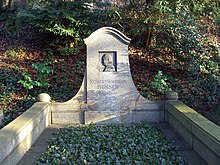 Bunsen's grave in Heidelberg's Bergfriedhof
- Robert Wilhelm Bunsen, by G. Lockeman, 1949.
- Sir Henry Roscoe's "Bunsen Memorial Lecture," in: Trans. Chem. Soc., 1900, reprinted (in German) with other obituary notices in an edition of Bunsen's collected works published by Wilhelm Ostwald and Max Bodenstein in 3 vols. at Leipzig in 1904. This is Gesammelte Abhandlungen von Robert Bunsen: im Auftrage der Deutschen Bunsen-Gesellschaft für angewandte Physikalische Chemie hrsg. von Wilhelm Ostwald und Max Bodenstein. 3 Bände. Leipzig: W. Engelmann, 1904
- Crew, H. (1899). "Robert Wilhelm Bunsen". The Astrophysical Journal 10: 301 – 305. doi:10.1086/140654. Retrieved 2008-09-12.
- Robert Wilhelm Bunsens Korrespondenz, edited by Christine Stock, Wissenschaftliche Verlagsgesellschaft Stuttgart, 2007.

External links
 | Wikisource has the text of the 1911 Encyclopædia Britannica article Bunsen, Robert Wilhelm von. |
Subscribe to:
Comments (Atom)